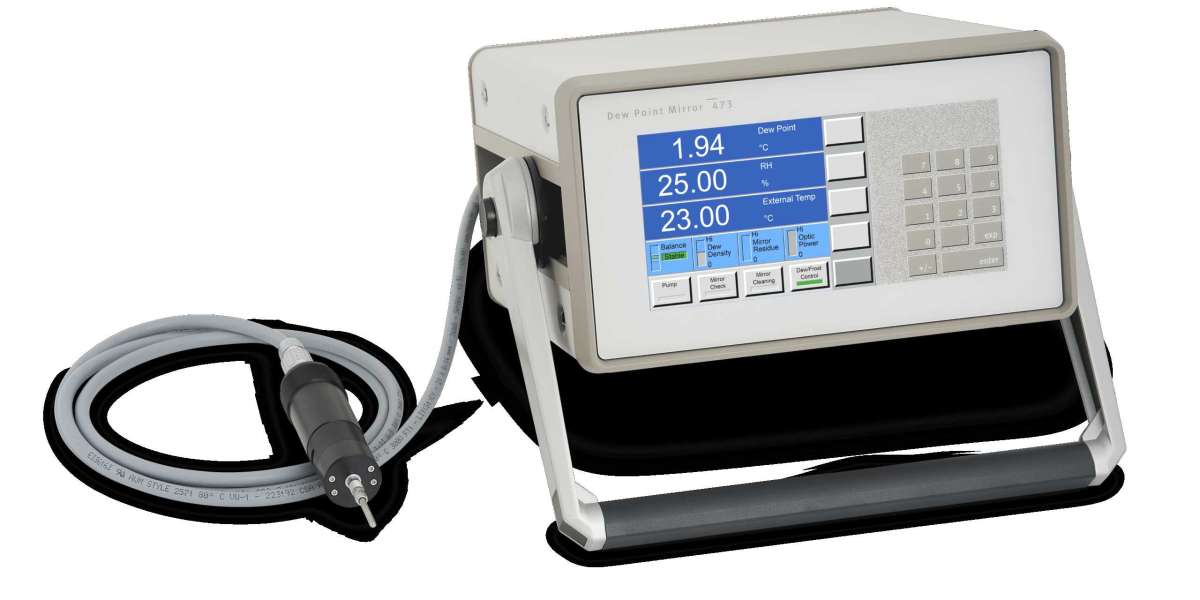

In the landscape of humidity and moisture measurement technology, there exists a hierarchy of accuracy — a spectrum that ranges from adequate to exceptional, from estimated to fundamental, from inferred to directly observed. At the very pinnacle of this hierarchy, occupying a position of unrivalled measurement authority that no competing technology has ever genuinely challenged, sits the chilled mirror hygrometer. This extraordinary instrument does not approximate moisture content through secondary indicators or infer dew point through empirical correlations — it measures the precise temperature at which water vapor in a gas sample begins to condense onto a physical surface, delivering a measurement of such fundamental scientific integrity that it has been adopted as the reference standard for humidity measurement by national metrology institutes, calibration laboratories, and regulatory bodies across the world. Dew-Point has dedicated itself to designing and manufacturing chilled mirror hygrometer instruments that represent the very finest expression of this gold standard technology — delivering measurement performance, long-term reliability, and application expertise that professionals across every demanding industry trust without reservation.
The Scientific Foundation of the Chilled Mirror Hygrometer
The operating principle of the chilled mirror hygrometer is one of the most elegant examples of direct physical measurement in all of analytical instrumentation. Rather than relying on a secondary sensing material whose properties change in response to moisture — as capacitive, resistive, and gravimetric sensors do — the chilled mirror hygrometer measures dew point by directly observing the physical phenomenon of condensation. This directness is the source of its extraordinary measurement authority.
The instrument operates through a beautifully simple yet technically demanding process. A highly polished mirror surface — typically fabricated from a thermally conductive material such as gold-plated copper or stainless steel — is cooled with precision by a thermoelectric Peltier device. As the mirror temperature falls, the sample gas flowing across its surface approaches and then reaches its dew point. At the precise moment condensation begins to form on the mirror surface, the optical characteristics of the surface change — reflected light scatters rather than returning cleanly to the detector. A photodetector continuously monitors this reflected light intensity, and when it detects the characteristic change associated with condensation onset, the control system records the mirror temperature at that exact moment. This temperature is the dew point of the sample gas — measured not by inference or correlation but by direct physical observation.
Dew-Point has refined every aspect of this measurement process across decades of chilled mirror hygrometer development — optimizing mirror materials, thermoelectric cooling systems, optical configurations, and control electronics to deliver instruments that achieve the measurement precision, response speed, and long-term stability that demanding professional applications require.
Why the Chilled Mirror Hygrometer Remains the Gold Standard
The humidity measurement market offers numerous sensor technologies — capacitive polymer sensors, aluminum oxide sensors, resistive sensors, and various optical approaches — each with its own combination of strengths, limitations, and appropriate application domains. Understanding why the chilled mirror hygrometer occupies a position of unique authority in this landscape requires an examination of what fundamentally distinguishes direct measurement from indirect measurement in scientific instrumentation.
Every sensor technology other than the chilled mirror hygrometer measures dew point or humidity through a secondary physical or chemical property that changes in response to moisture — the capacitance of a polymer layer, the impedance of an aluminum oxide film, or the resistance of a hygroscopic material. These secondary measurements must be related back to actual moisture content through calibration — a process that establishes the relationship between the sensor's output and the true moisture value at the time of calibration. Over time, as the sensor material ages, as contaminants accumulate, or as the physical properties of the sensing element drift, this calibration relationship changes — and the accuracy of the measurement degrades.
The Dew-Point chilled mirror hygrometer is immune to this class of degradation because it does not rely on a secondary sensing material at all. Its measurement is based on the physical phenomenon of condensation — a phenomenon governed by fundamental thermodynamic laws that do not change over time, do not drift with sensor aging, and are not affected by contamination in the ways that secondary sensing materials are. This fundamental measurement stability is the primary reason that chilled mirror hygrometer instruments from Dew-Point deliver the long-term accuracy and reliability that reference measurement applications demand — and the primary reason they are chosen for calibration laboratory use, regulatory compliance measurement, and any application where measurement drift is not acceptable.
Applications Where Dew-Point's Chilled Mirror Hygrometer Is the Instrument of Choice
The exceptional measurement authority of the Dew-Point chilled mirror hygrometer makes it the preferred choice across a specific range of applications where measurement accuracy, traceability, and long-term stability are paramount requirements.
National Metrology and Calibration Laboratories — The most fundamental application of the chilled mirror hygrometer is as the primary reference standard for humidity measurement. National metrology institutes use chilled mirror instruments to realize and disseminate the national humidity scale — the foundation on which all traceable humidity measurements in a country ultimately rest. Dew-Point instruments are designed and manufactured to meet the exacting requirements of this application, with measurement uncertainties that satisfy the most demanding metrological standards.
Pharmaceutical Manufacturing and Quality Assurance — The pharmaceutical industry operates under regulatory frameworks that demand documented, traceable, and auditable evidence of environmental control throughout the manufacturing process. Cleanroom humidity, drying process conditions, and storage environment monitoring all require measurement instruments whose accuracy can be demonstrated through unbroken chains of traceability to national measurement standards. The Dew-Point chilled mirror hygrometer provides this traceability as an inherent feature of its measurement principle — making it the natural choice for pharmaceutical applications where regulatory compliance is non-negotiable.
Semiconductor and Electronics Manufacturing — The fabrication of semiconductor devices at nanometer scales requires process environment control of extraordinary precision. Moisture levels that would be entirely inconsequential in most industrial environments can cause catastrophic yield losses in semiconductor manufacturing — making ultra-precise, ultra-reliable moisture measurement a genuine operational priority. Dew-Point chilled mirror hygrometer instruments provide the measurement accuracy and long-term stability that semiconductor manufacturers need to maintain the process environment control their operations demand.
Natural Gas Quality Assessment — The natural gas industry uses chilled mirror hygrometer measurements to verify the moisture content of gas streams at custody transfer points — the locations where gas changes ownership between producer, transporter, and distributor. At these points, measurement accuracy has direct and significant financial implications, making the fundamental accuracy of the chilled mirror hygrometer a commercial as well as a technical requirement. Dew-Point instruments designed for natural gas applications incorporate the pressure handling capability, sample conditioning systems, and measurement range necessary for accurate moisture assessment across the full range of pipeline operating conditions.
Aerospace and Defense Testing — Environmental test chambers used to qualify aerospace components and defense systems must maintain precisely controlled temperature and humidity conditions that can be documented with the highest level of measurement confidence. The Dew-Point chilled mirror hygrometer provides the reference-grade measurement capability that aerospace test facilities require — instruments whose accuracy is beyond question and whose measurement documentation satisfies the most demanding qualification standards.
Meteorological Reference Measurement — Weather services and climate research institutions use chilled mirror hygrometer instruments as reference standards against which field instruments are calibrated and validated — ensuring that the atmospheric humidity data underlying weather forecasting and climate modeling is anchored to measurements of the highest possible accuracy.
Key Features of Dew-Point's Chilled Mirror Hygrometer Range
Dew-Point designs its chilled mirror hygrometer instruments with a comprehensive set of features that address the full range of requirements its professional customers bring to every application.
Measurement ranges extending from −80°C dew point to +95°C dew point cover the full spectrum from ultra-dry industrial gas streams to near-saturated atmospheric conditions. Measurement accuracy to ±0.1°C dew point satisfies the requirements of the most demanding reference measurement applications. Dual-wavelength optical systems that can distinguish between dew and frost on the mirror surface ensure accurate measurement across the full temperature range — including sub-zero conditions where the distinction between liquid condensation and ice crystal formation has a significant impact on measurement accuracy.
Automatic contamination detection systems alert operators when mirror surface contamination is affecting measurement integrity — preventing undetected measurement errors while minimizing unnecessary maintenance interventions. Multiple digital and analog output options including 4–20 mA, RS-232, RS-485, and MODBUS enable seamless integration into any process control or data acquisition infrastructure.
The Dew-Point Commitment to Measurement Excellence
Choosing a Dew-Point chilled mirror hygrometer is not simply a purchase decision — it is a commitment to measurement excellence that will deliver returns across the full operational life of the instrument. From initial specification and application consultation through calibration, installation support, and long-term service, Dew-Point supports every instrument it supplies with the expertise and dedication that genuine measurement authority demands.