
So, we were faced with an increasingly fragile economy and a field that we knew and loved was being challenged in new and potentially serious ways," she says.
She would carry on practicing, get some more clinical experience, go to conferences as and when she had the time and slowly get more involved and build up her area of interest.
What she wasn't prepared for was that a single exchange with one patient would alter the course of her professional life.
Our patient was a 32-year-old woman who had been trying to get pregnant for many years. All investigations had been undertaken by her elsewhere, and she now arrived, with a file full of reports, questions and uncertainty.
Dr. Ananya would have been able to provide guidance on the basics. She understood what infertility assessment was, and that multiple underlying conditions could cause infertility. However, as the consultation went on, the questions got more specialised.
"Should we consider IVF?"
"What happens after the eggs are retrieved?"
"What is the role of the embryologist?"
"How do you decide which treatment is appropriate?"
Dr. Ananya answered what she could. But after the consultation, she found herself thinking about the questions she could not answer with the confidence she wanted.
That evening, she made a decision.
She wanted to learn more about reproductive medicine.
And that was the beginning of her journey towards a Fellowship in IVF.
When Medical Knowledge Is Not the Same as Specialised Expertise
It is true that like other professionals, Dr. Ananya did not stop studying.
The medical field has taught her that one of the key lessons is that completion of a qualification does not necessarily mark the end of the study process. New research is emerging.
But reproductive medicine felt different.
The more she explored the field, the more she realised how many disciplines came together in fertility care.
There was reproductive endocrinology.
There was infertility evaluation.
There was male-factor infertility.
There was embryology.
There was laboratory science.
There were procedures such as IUI, IVF and ICSI.
And behind every treatment decision was a patient or couple hoping for a successful outcome.
She realised that learning IVF was not simply about learning a procedure. It was about understanding the entire clinical pathway.
The First Step: Understanding Infertility
Dr. Ananya began by revisiting the fundamentals.
Before IVF, there was infertility.
Before infertility treatment, there was diagnosis.
And before diagnosis, there was the patient.
She started studying the different causes of infertility and how they could affect treatment planning.
Age could influence reproductive potential.
Ovarian reserve could provide important information about ovarian function.
Issues related to tubal may interfere with conception.
Issues relating to endometriosis may have an effect on fertility.
There may be issues regarding male factor infertility.
There may be more than one factor involved.
At other times, after thorough investigation, there may still be no identifiable cause found. This made one thing clear to her: an IVF professional needs to understand why a particular treatment may be considered before understanding how the treatment is performed.
Why a Fellowship in IVF Became the Next Step
The more Dr. Ananya studied independently, the more she realised that scattered learning had its limitations.
She could attend a webinar one week and read an article the next. She could watch a recorded lecture or listen to a conference presentation.
But she wanted something structured.
She wanted a curriculum.
She wanted expert guidance.
She wanted case discussions.
Most importantly, she wanted to understand how the different pieces of reproductive medicine fit together.
That was when she began exploring a Fellowship in IVF.
A structured fellowship could help her move from isolated knowledge to a more organised understanding of assisted reproductive technology.
She looked for a programme that covered areas such as:
- Female infertility
- Male infertility
- Reproductive endocrinology
- Ovarian stimulation
- Ovulation induction
- IUI
- IVF
- ICSI
- Embryology
- Recurrent implantation failure
- Fertility preservation
- Case-based learning
- Clinical decision-making
But there was another consideration.
Dr. Ananya was already practising.
She could not simply put her professional responsibilities on hold.
That led her to explore another option.
Could Online Learning Fit into a Doctor’s Schedule?
The rise of Online Infertility Courses in India had changed the way many healthcare professionals approached continuing education.
For Dr. Ananya, this was particularly relevant.
She did not need another course that simply gave her information. She needed a learning format that could fit around clinical responsibilities without compromising the depth of the academic content.
Online learning offered that flexibility.
She could attend academic sessions without travelling every day.
She could revisit concepts that required additional study.
She could learn at a pace compatible with her professional schedule.
But she also understood an important distinction.
Online education could provide the academic foundation, but clinical and practical learning had a different role.
She therefore began looking for programmes that combined digital academic learning with appropriate practical or clinical components.
That became an important part of her decision-making process.
From Textbooks to Patient Cases
One of the most valuable changes in Dr. Ananya's learning came when she began looking at infertility through case-based discussions.
A textbook could explain diminished ovarian reserve.
A lecture could explain ovarian stimulation.
But a patient case forced her to think differently.
What if the patient was 38?
What if ovarian reserve was reduced?
What if there was also male-factor infertility?
What if the couple had already undergone an unsuccessful IVF cycle?
What if the patient had recurrent implantation failure?
The answers were no longer simply about remembering information.
They were about understanding the reasoning behind clinical decisions.
That was when Dr. Ananya began to appreciate the value of structured fellowship training.
Understanding What Happens Inside the IVF Laboratory
Until then, she had thought about IVF primarily from the clinical side.
Her learning introduced her to another world—the IVF laboratory.
She began understanding the role of embryologists and the importance of laboratory procedures in assisted reproduction.
Egg retrieval was only one part of the process.
Following retrieval, the laboratory became central to the next stages of treatment.
Sperm preparation.
Fertilisation.
Embryo culture.
Embryo assessment.
Cryopreservation where appropriate.
The more she learned, the more she appreciated that IVF was a multidisciplinary process.
The doctor, embryologist, andrology team, nurses and other healthcare professionals all contributed to different parts of the patient's journey.
This understanding changed the way she looked at fertility treatment.
Learning from a Fertility Care Environment
Finally, Dr. Ananya was able to identify what she needed to know.
So how does all of this translate in a fertility centre?
Reading about an IVF flow was another.
The other one was watching how the fertility team works.
Her clinical experience helped her to familiarize with the patient pathway from their first clinic visit, through various investigations, planning of treatment and assisted reproductive techniques.
She observed how doctors considered the patient's age, medical history, investigations and previous treatment before developing an individualised approach.
She also saw how closely the clinical and laboratory teams worked together.
This reinforced another lesson:
IVF is not a single procedure. It is a coordinated patient-care pathway.
The Role of an IVF Doctor in Bangalore
Bangalore has developed into an important healthcare and medical education hub, with specialised fertility services available to patients from the city and other parts of India.
For a doctor interested in becoming an IVF doctor in Bangalore, understanding the clinical environment is therefore an important part of professional development.
But the title itself is not the learning objective.
The objective is developing the knowledge, skills and experience required for appropriate fertility care within one's professional scope.
An aspiring fertility professional needs to understand infertility evaluation before treatment.
They need to understand reproductive endocrinology.
They need to appreciate the role of embryology.
They need to understand how male and female factors can interact.
And they need to recognise that every patient requires an individualised clinical approach.
For Dr. Ananya, this was becoming increasingly clear.
What Medline Academics Added to Her Journey
As she explored structured training options, Dr. Ananya discovered Medline Academics.
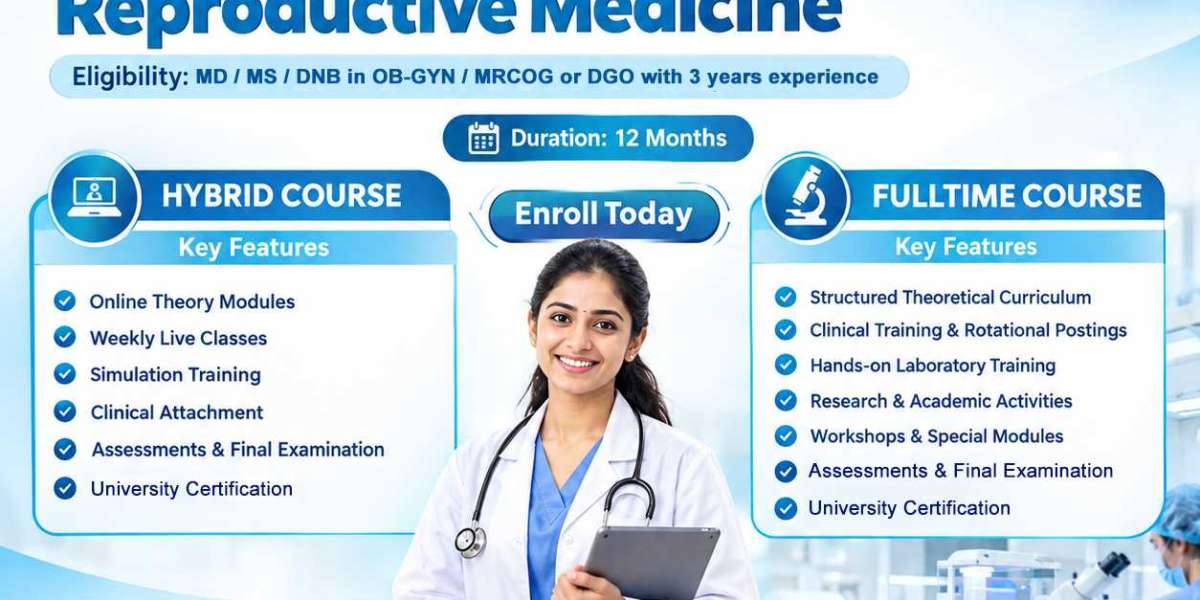
Medline Academics is dedicated to specialised medical education, and offers courses that are structured to guide healthcare professionals through the process of learning more about all aspects of reproductive medicine and infertility. Its courses combine the best of academic learning, expert-led guidance, case-based learning and hands-on practice, depending on the programme. For a doctor seeking to apply for a Fellowship in IVF, this structured approach may be an ideal way to streamline a learning process that covers everything from infertility evaluation and reproductive endocrinology through to assisted reproductive technology and embryology. Hybrid learning can also find its applications among working people who are seeking specialized education with the flexibility that it offers. In contrast to considering online education as a substitute to clinical learning, this method will integrate academic learning and practical/clinical learning, thus helping the learner to understand the application of the concepts in actual cases of fertility treatment. The worth of such a course for Dr. Ananya is not in doing another course but in gaining a systematic approach towards infertility treatment and reproductive medicine.
Seeing Reproductive Medicine in Clinical Practice
Her clinical exposure gave her another perspective. At Dr. Kamini Rao Hospitals, she was able to understand the multidisciplinary nature of fertility care within a specialised clinical environment. Dr. Kamini Rao Hospitals is associated with women's healthcare and reproductive medicine, including fertility evaluation and assisted reproductive services. For a professional pursuing advanced learning in reproductive medicine, exposure to such an environment can help connect academic concepts with clinical workflows, from patient consultation and infertility evaluation to treatment planning and assisted reproductive procedures. The clinical setting further underlines the value of a well-integrated reproductive medicine team, including embryologists, andrology specialists, nurses and other trained professionals. For doctors keen to expand their perspective of IVF and other fertility treatments in a fertility care network like Bangalore, experiencing the vibrant clinical setting can be helpful to understand how patient-centred fertility care is delivered.
For Dr. Ananya, this experience reinforced what she had been learning throughout her fellowship.
The science mattered.
The technology mattered.
But so did the patient.
The Question Changed
After a number of months of that first consultation, Dr. Ananya encountered another patient with the same problem.
The patient was trying to conceive and had undergone many tests.
There seemed to be something different about this conversation.
Dr. Ananya was not quick to bring up IVF.
She first listened.
She reviewed the history.
She considered the available investigations.
She explained the possible factors involved.
Then she discussed the treatment options appropriate to the patient's situation.
The difference was not that she suddenly knew every answer.
The difference was that she knew how to approach the question.
That was perhaps the most important thing her training had given her.
Is a Fellowship in IVF Right for You?
The starting point for any doctor choosing to undertake special training must be the personal objectives that they have set themselves.
A Fellowship in IVF might suit health care professionals who desire to learn more about infertility and assisted reproduction.
Before enrolling, prospective participants should consider:
- Does the curriculum cover the fundamentals as well as advanced concepts?
- Are reproductive endocrinology and infertility evaluation included?
- Does the programme address embryology and laboratory processes?
- Are there case-based discussions?
- Is there practical or simulation-based learning?
- Is clinical exposure included?
- Is the learning format suitable for working professionals?
- What are the eligibility requirements?
- What certification is provided?
Similarly, when evaluating Online Infertility Courses in India, learners should look beyond convenience and assess the curriculum, faculty, interaction, assessments and practical components.
From Learning to the Next Chapter
Dr. Ananya's journey did not end when her fellowship ended.
In fact, it had only changed direction.
She continued reading.
She attended professional programmes.
She discussed cases with colleagues.
She kept learning about developments in reproductive medicine.
Because that is the reality of modern healthcare.
A fellowship can provide a foundation.
Online education can make continuing learning more accessible.
Clinical exposure can connect knowledge with practice.
But the process of professional development is a continuous one.
If you are a doctor looking for ways of developing yourself professionally in terms of fertility treatments, then learning from programs and clinics specializing in such procedures may play a key role in your professional development journey.
If your aspirations include becoming a Fellow in IVF, learning about Online Infertility Courses in India, or getting to know about the requirements to become an IVF doctor in Bangalore, then the first thing you have to do is define a learning path for yourself.
Your Journey Can Begin with One Question
You may not know exactly where your career in reproductive medicine will take you.
You may simply know that you want to understand infertility better.
You may want to strengthen your existing clinical practice.
Or you may be ready to explore IVF as a specialised area of professional development.
Whatever your starting point, the right education can help turn curiosity into structured knowledge—and structured knowledge into greater clinical confidence.
Explore the Fellowship in IVF and specialised reproductive medicine programmes offered through Medline Academics and take the next step in your professional learning journey.






